What happens when the economy Doesn't serve people?
Maybe real innovation doesn't start with better technology, but with better demand.
Who ultimately serves an economic system: the platform, the numbers, or the people who make the system work?
Taxiter starts in the taxi world. Not because we claim that everything has to be different, but because we believe that there is room to look again at how a taxi app can work for passengers, drivers and the platform itself.
A taxi app is never just software.
A taxi app connects people. A traveler who wants to go somewhere. A driver who does his job and a platform that connects both.
The Dutch taxi market is changing.Technology is changing.
But with another question: "What would a taxi app look like if we could start again? '
That means for our attention to clarity, care, simplicity and an experience that both travelers and drivers take seriously.
Maybe we shouldn't just build better platforms. Maybe we should design better economic relationships.
The taxi world is our starting point. But the question that concerns us is greater.
What happens when economic efficiency becomes more and more important, while people behind that economy experience less and less influence?
That is not an assessment of one company, one platform or one sector.
It is a question that we consider relevant to the way digital economies develop.
We don't know what the future looks like. And we're not saying that one model has all the answers.
We just think it's time to ask questions again.
People above model
A ride is never just a transaction. There's a human on both sides.
Efficiency is not the endpoint
Technology can make processes more efficient . The question is what will ultimately achieve this efficiency.
New ratios
When markets change,new ways to organise value and cooperation arise.
That's why we build
Taxiter investigates what a taxi app looks like when design starts in people.
Built for the Dutch taxi market.
From a taxi to Schiphol from Amsterdam to a ride through Rotterdam, Utrecht, The Hague, Eindhoven or Groningen: the need remains simple.
People want to know where they stand. Order a cab. Book a cab. Find a driver. Arrive in time.
That sounds obvious. That is precisely why we believe that the technology around it should not be unnecessarily complicated.
Taxiter is being developed for the reality of the Dutch taxi market: travellers, self-employed taxi drivers, taxi entrepreneurs and the cities in which they meet.
From Amsterdam to Maastricht.
Taxiter focuses on the Dutch market.The cities below are part of the market where Taxiter wants to develop.
Calling a city does not mean that Taxiter there is currently operational.
The taxi world may be just the beginning.
Platform economies are strong in scale, speed and efficiency.
But when interests are perceived differently for a long time by the different parties within a platform, friction can arise.
In the taxi world, this friction can be expressed in different ways: drivers can make different choices, cooperation can change and collective actions or strikes can become part of the public conversation.
We do not predict that this will necessarily happen. We also do not want to judge future actions.
Our thought is simpler: When a market changes, it is wise to not only respond to problems, but also to think ahead on better alternatives.
That's why we build Taxiter.
Another taxi app starts with a different way of thinking.
Not because we have all the answers . But because we believe good products start with good questions.
Taxiter in brief.
What is Taxiter?
Taxiter is a Dutch taxi app in development. The platform is designed from a different perspective on the relationship between traveler, driver and technology.
Is Taxiter Already available?
Taxiter is currently under development. Availability shall be disclosed as soon as the service is effectively operational.
In which cities Taxiter?
Taxiter focuses on the Dutch taxi market. Amsterdam, Rotterdam, Utrecht, The Hague, Eindhoven, Groningen and Schiphol are relevant markets.
Is Taxiter an alternative to other taxi apps?
Taxiter is developed as an independent platform. The starting point is not simply to copy existing taxi apps, but to re-examine how to design a taxi app.
Is Taxiter active at Schiphol?
Not necessarily. Calling Schiphol or any other Dutch city does not mean that Taxiter currently offers rides there. Availability is indicated only when the service is actually operational.
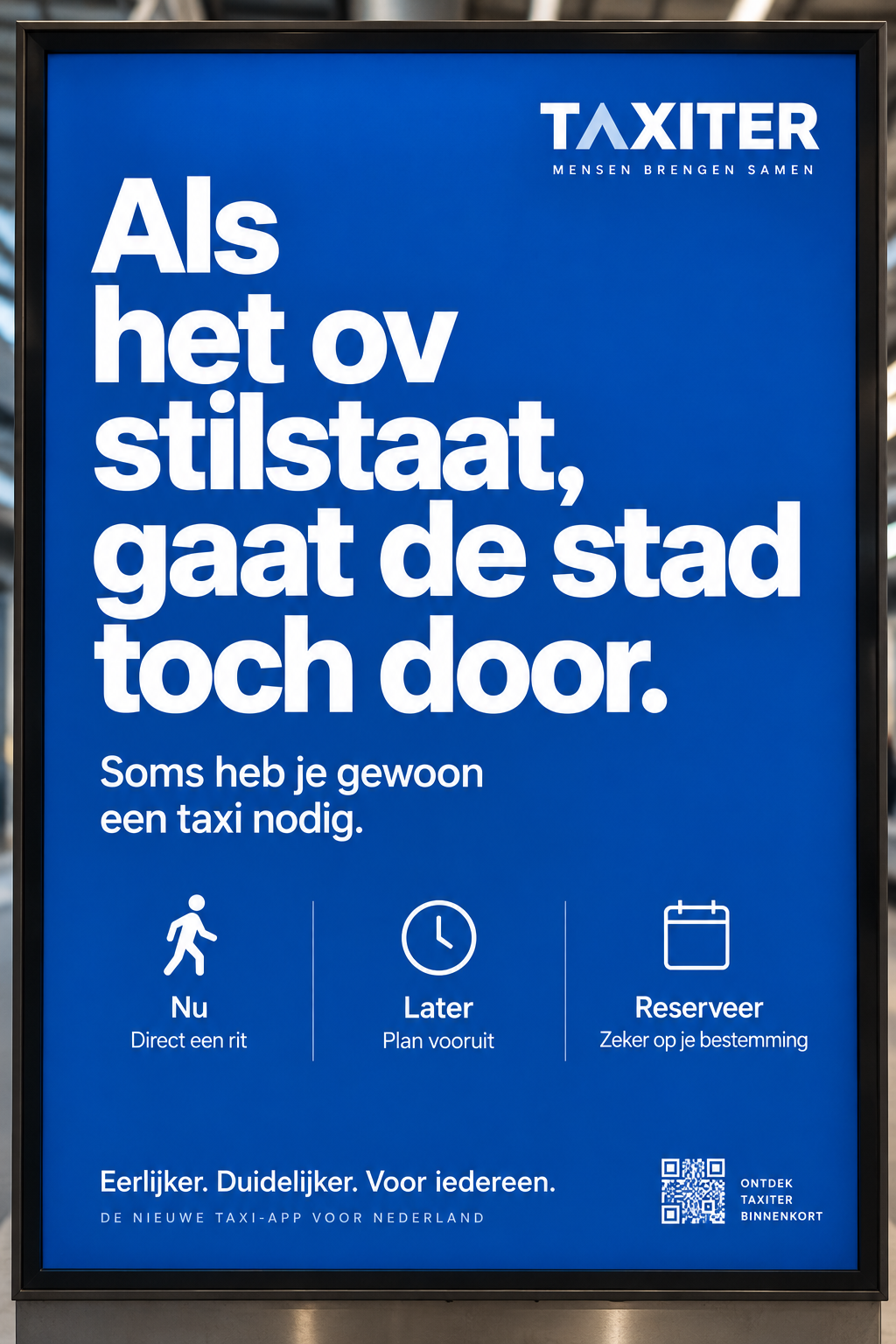
Passenger App


Driver app


Designed by
© 2026 TAXITER
All rights reserved
A CIRCLE movement
Designed by
© 2026 TAXITER
All rights reserved
A CIRCLE movement